by David Scott
On May 8, I gave a presentation at the annual convention of the Meritas organization about why sustainability matters to lawyers (Meritas is an international affiliation of about 6,000 lawyers in 80 different countries throughout the world). Basically, the reason why sustainability matters to lawyers is pretty simple: Because it matters to our clients. The more detailed reason why sustainability matters to lawyers is essentially a function of the “triple bottom line,” meaning: 1. people, 2. planet, 3. profits.
People, or businesses, want their attorneys to understand them and/or their business. If their industry is evolving (or, in some cases, being created) by emerging sustainability trends, then it may be important for their lawyer understand the unique challenges they face and, ideally, be positioned to help them meet those challenges. Trying to gain that understanding was one of the primary purposes of the Meritas presentation.
The planet needs all the help that it can get these days. No matter what your political or personal beliefs or value system, there is no debating that we have a finite amount of natural resources and we are using many of those resources at rates that are not sustainable. So I see no downside to increasing efficiency and reducing waste. There are many ways that lawyers can become more responsible global partners and my Meritas group created the “Green Guide” to detail steps that law firms can take to be more sustainable. If you would like a copy of the Green Guide, just let me know and I’m happy to email you a copy.
No matter how worthwhile the goal of sustainability may be, at the end of the day law firms are still businesses and the goal is to be profitable. Our presentation explained why sustainability and profitability are not incompatible. We found the opposite to be true. More efficient and less wasteful practices save money. Unique and/or innovative practices generate media attention and free publicity. Like-minded clients (and potential clients) gravitate toward firms that share their values … which takes us full circle back to the “people” aspect.
I feel truly fortunate to be part of an organization like Meritas that sees the value of sustainability, to be part of a firm that supports Meritas’ mission, and to have met the outstanding group of people that contributed to our presentation.
Special recognition goes to our outstanding group of panelists and our moderator. In alphabetical order, the panel included Josh Arnold, JD, MBA, LEED AP, of 360 Green, Inc. Josh has dedicated the last 15 years of his professional life to the interplay between sustainability and business, he teaches a course on the subject at the University of Wisconsin-Madison, and he has consulted on construction projects totaling over $3 Billion. Panelist David Fitch is the President and CEO of Gables Residential, a privately owned REIT, which owns, develops and manages multi-family communities and mixed-use developments, as well as provides furnished corporate and short-term apartment accommodations nationwide. Gables has implemented a host of green initiatives and stands on the front lines of the green construction revolution. Panelist Mark Hall is the Senior Vice President of Environmental Power Corporation, a developer, owner and operator of clean energy production facilities. Environmental Power is on the vanguard of the renewable energy movement and Mark offered a fascinating discussion of anaerobic digestion. Panelist Jim Lime is the Vice President of Environment and Safety at Con Agra. Jim is an eloquent speaker and delivered a highly informative presentation about the impact of sustainability with respect to the supplier’s code of conduct being implemented by industry giants such as Wal-Mart. Panelist Michael Manuel is the Chair and founder of the Climate Change and Resource Conservation practice group at the Chicago law firm of Goldberg Kohn. Michael’s establishment of this group over a year ago speaks to his vision and dedication to emerging sustainability trends and the legal repercussions. Last but not least, our moderator was J.D. Head, managing partner of Fritz, Byrne, Head & Harrison, PLLC in Austin, Texas. J.D. practices environmental and administrative law and did an excellent job keeping things on point and moving along.
Read more!
May 13, 2008
Meritas Leadership Institute Sustainability Project Presentation
May 7, 2008
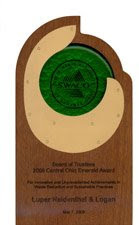
Luper Neidenthal & Logan named SWACO Board of Trustees Emerald Award Winners!
Awards are also given individually under five other categories of leadership, innovation, partnership, entrepreneurship, and environmental education. However, the winner of the Board of Trustee Award must meet all of the criteria in the five other categories. SWACO awards the Board of Trustee Emerald Award to companies that are innovative and have unprecedented achievements in Environmental Stewardship and Leadership.
Roger Whitaker, Nicole Vanderdoes, and Amanda Bucha attended the event that drew approximately 500 people. Mike Jackson of NBC 4 was the master of ceremonies, and actor Ed Begley, Jr. (of St Elsewhere, Boston Legal, HGTV’s “Living with Ed”, among many more) was the Keynote Speaker. While describing our efforts in the award presentation, SWACO mentioned our Thinking Globally Acting Locally initiative, our proprietary software, our paperless system, our recycling efforts, our double-sided copying policy, our use of recycled paper, and that we were the first Ohio law firm to be named a Climate Challenge Partner by the American Bar Association.
We would like to congratulate the other winners of the SWACO Emerald Awards!!
Other winners under the 5 other categories were:
- Leadership: ReSTORE of the Columbus Chapter of Habitat for Humanity
- Innovation : White Castle Restaurants
- Environmental Education: The Columbus Zoo and Aquarium (My House at Habitat Hollow exhibit) and the Ohio State University William Schiermeier Olentangy River Wetland Research Park
- Entrepreneurship: E-cycle
- Partnership: The Waste Not Center
- Litter Clean-Up: Adena Brook Community
We also thank all of our employees for their cooperation as we have implemented these changes in our office. We know it’s not always easy to make changes, but as speaker Ed Begley, Jr. said, “We can do this!” We encourage others to start making eco-conscious changes today!
Mar 31, 2008
LNL Acting Locally in Support of the “Get Green Columbus” Business Conference
We offered complimentary energy efficient light bulbs (packaged in recyclable boxes), we distributed a brochure and displayed a PowerPoint presentation (prepared by our own Lisa Price) outlining what our firm is doing to think globally and act locally. We enjoyed meeting many dedicated and energetic attendees and were pleased with how receptive everybody seemed to our exhibit.
We enjoyed participating in this event and appreciate the opportunity to do a small part in helping other like-minded companies and organizations encourage more sustainable practices in Columbus and Central Ohio. We look forward to participating in similar events in the future! Here are some great photos from the event!


Mar 21, 2008
The New Quest for Paper
by Amanda Bucha
The world of recycled paper can be a confusing place. From Forest Stewardship Council (FSC) certified paper to paper with 100% recycled post consumer content, it can be difficult to determine which one is truly the most environmentally friendly. The following information should help anyone on a venture into this uncharted territory.
Recycled paper comes in a variety of forms, so it’s important to familiarize yourself with the available options. Having this knowledge will allow you to make an informed decision and to select the paper that meets your environmental goals.
Paper companies will often refer to the content of recycled or reprocessed materials that were used to make the paper. This content is typically measured as a percentage of the total weight of the paper. There are two types of content -- Post-consumer content and Pre-consumer content.
Post-consumer content paper contains materials that were once consumer items. These various items served their purpose and are then changed into post-consumer recycled fibers. For example, the paper you throw into the recycle bin will later be used to make post-consumer recycled paper.
In contrast, Pre-consumer content paper is made up of the scraps that were left over when the paper was being made. This type of material never became a consumer item, but it wasn’t discarded either. Instead, it was used to make new paper. For example, the leftover pulp that is used to make paper at a paper mill, is theoretically picked up off the floor and turned into pre-consumer content paper.
When looking at the content of recycled materials, it’s important to look at the percentage. This will usually appear near the recycled paper symbol. The higher the percentage, the more eco-friendly the paper will be. If your goal is to attain the most environmentally friendly of the two, then most agree that your choice should be “post-consumer” paper with 100% recycled content.
When you see the Forest Stewardship Council Certified (FSC) logo on paper materials, this means that the paper comes from forests that have been managed responsibly and in an environmentally conscious way. In order to become certified, these forests must be managed in accordance to strict rules enforced by the FSC. However, it’s important not to assume that this paper is recycled. For example, FSC papers can contain 0% recycled content. The message that the FSC logo sends to the consumer is that the forests and environment are not being harmed by the paper making process. Much of the FSC certified paper that is available does contain recycled content. Again, if the goal is to attain the most environmentally friendly paper, then the FSC paper with the highest recycled content is the best FSC paper.
Finally, more and more paper products are coming from non-tree sources. For example, cotton, hemp, and agricultural waste are being used with more frequency. If you are concerned about the loss of trees in paper production, then purchasing paper made from non-tree sources will be an important consideration.
The most eco-friendly paper will contain 100% post-consumer recycled content. If you are using paper that is FSC certified, make sure that at least 50% of the content is coming from post consumer recycled sources.
To conclude, the best thing you can do to reduce your impact is to follow three simple steps. First, reduce the amount of paper you are using by implementing double sided copying policies, creating a paperless workflow by using email or using fax programs that are combined with email accounts, and encourage employees to cut down on unnecessary paper usage. Second, recycle the paper you do use. Finally, use the most environmentally friendly paper you can find.
Hopefully these guidelines will help you on your quest in the “new paper era”.
Read more!